

Electrical panel numbering explained: how breaker slots are numbered
Learn how breaker panel numbers work. See odd and even columns, tandem breakers, and double-pole breakers.
Breaker numbers are a map. They show where each breaker sits in the panel.
In many home panels, the odd numbers go down the left side. The even numbers go down the right side. The top row is 1 and 2. The next row is 3 and 4. Then come 5 and 6.
This explains a common puzzle. A double-pole breaker on the left uses 1 and 3. It does not use 1 and 2. A tandem breaker can hold two circuits in one numbered spot.
Always follow the numbers printed on your own panel and door card. The odd-left, even-right pattern is common, but not every panel uses it.
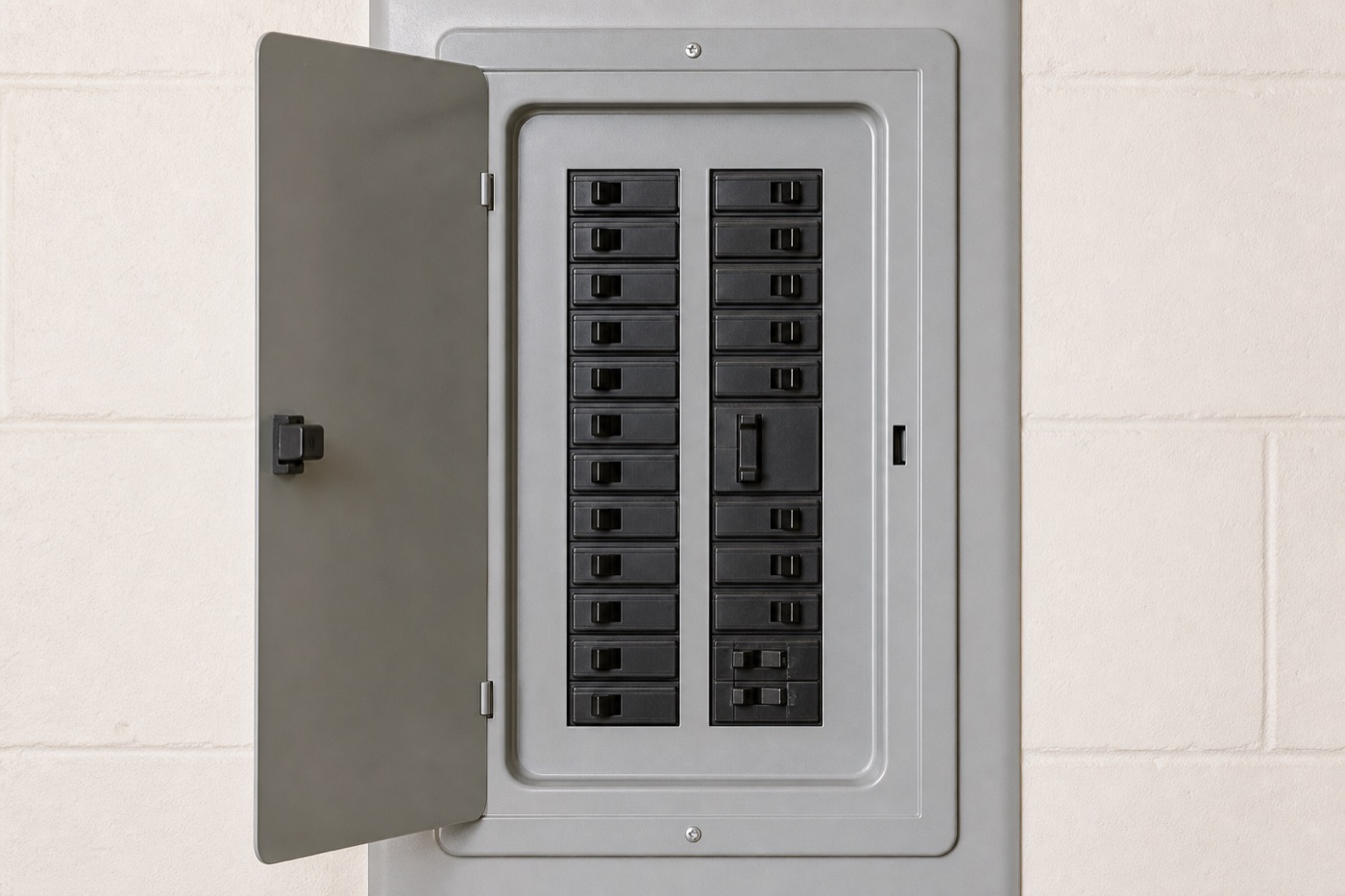
The common breaker number pattern
Most home panels have two columns. Read the numbers across each row, then down.
| Left side | Right side |
|---|---|
| 1 | 2 |
| 3 | 4 |
| 5 | 6 |
| 7 | 8 |
| 9 | 10 |
So slot 1 is at the top left. Slot 2 is at the top right. Slot 3 is right below slot 1. Slot 4 is right below slot 2.
Schneider Electric uses this odd and even pattern for many panels. Still, do not guess. Some door cards use a different order. The panel itself is the answer.
Why a double-pole breaker uses 1 and 3
A double-pole breaker is one breaker with two linked handles. It takes two spots in one column. On the left side, the first pair is 1 and 3. On the right side, the first pair is 2 and 4.
| Where the breaker sits | Numbers to write down |
|---|---|
| Top left | 1 and 3 |
| Top right | 2 and 4 |
| Second left spot | 3 and 5 |
| Second right spot | 4 and 6 |
The breakers in spots 1 and 2 sit next to each other. They are not a normal double-pole pair. When you label a double-pole breaker, write both numbers. For example, write Range / oven: 1 and 3.
Double-pole breakers often run big home equipment, such as a dryer, range, water heater, heat pump, or air conditioner. Do not use the name of the equipment to guess what kind of breaker it has. Read the breaker and the panel first.
One spot can mean different things
The number tells you where a breaker is. It does not always tell you how many circuits are there.
Single-pole breaker
This is the usual kind. One breaker takes one spot and runs one circuit. If it is in spot 7, write its label next to 7.
Tandem breaker
A tandem has two small, separate handles in one spot. It runs two circuits. If it sits in spot 9, both circuits belong at spot 9. Label each handle. You might write 9 upper: hall lights and 9 lower: garage outlets.
Only some panels allow tandem breakers. Some allow them in only a few spots. Do not add one just because there is room. A qualified electrician can help if you are not sure.
Double-pole breaker
A double-pole breaker takes two spots, but it is one circuit. On the left, it might use 9 and 11. Give it one label and list both numbers.
Quad breaker
A quad breaker has several handles in a small space. Some handles may work together. Look for a handle tie and follow the maker’s marks. If you cannot tell which handles belong together, ask an electrician.
A few words to know
- Spot, slot, or space: One place where a breaker goes.
- Circuit: The path that carries power to lights, outlets, or equipment.
- Single-pole: One breaker in one spot.
- Double-pole: One linked breaker in two spots.
- Tandem: Two separate breakers in one spot.
You may see a panel called “20 spaces, 40 circuits.” That means it has 20 physical spots. It may be built to hold more circuits with approved tandem breakers. Check the panel label to see what it allows.
Make a clear panel list
Write your list in the same order as the panel. This makes it easier to use when a breaker trips.
- Put 1, 3, 5, and the other odd numbers in the left column.
- Put 2, 4, 6, and the other even numbers in the right column.
- For a double-pole breaker, write both numbers. For example:
Heat pump: 17 and 19. - For a tandem, keep both labels next to the same number.
- Write
sparefor an empty spot. If you do not know what a live breaker does, mark it as a guess until you can test it.
The free panel label generator can turn your list into a printout for the panel door. Need help finding each circuit first? Read how to map an unlabeled panel. Then use our guide to labeling your electrical panel.
Only touch breaker handles from outside the panel. Do not remove the cover. If you see heat, rust, damage, or burn marks, stop and call a qualified electrician.
Keep the same shape on your phone
Numbers are easier to check when the list looks like the real panel. Tobi’s electrical panel schedule keeps the same two-column shape. Odd spots are on the left. Even spots are on the right. Tandems share a spot. Double-pole breakers cover the two spots they use.
You can also mark a label as correct, a guess, or wrong. That helps everyone in the house know what they can trust.
Common questions
Are odd breaker numbers always on the left?
No. That pattern is common, but not every panel uses it. Read the numbers on your panel and door card.
Why are breaker 1 and breaker 3 linked?
They are stacked in the left column. A double-pole breaker can use those two spots as one circuit.
Does a tandem breaker have two numbers?
Usually, no. It has one panel number and two separate handles. Use upper and lower, or A and B, to show which label goes with each handle.
Can I put a tandem breaker in any empty spot?
No. The exact panel model decides where tandems are allowed. Have a qualified electrician make changes inside the panel.